
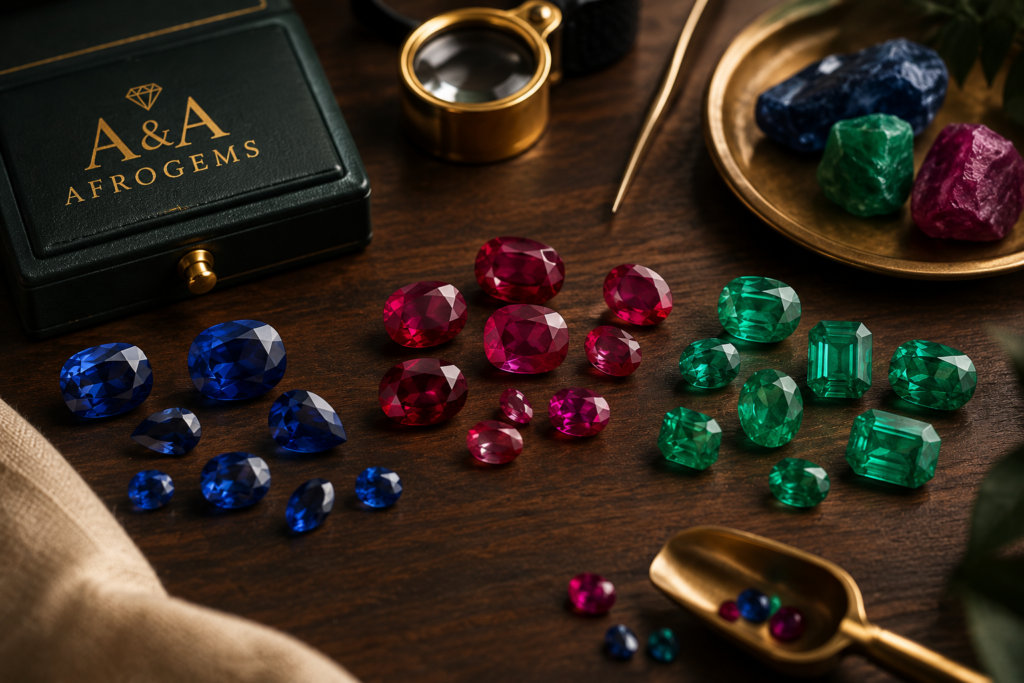
There is something unmistakable about colored gemstones. Diamonds may be famous for brilliance, but sapphires, rubies, and emeralds have something more personal: character. Their beauty is not only in how they shine, but in the depth of their color, the story of their origin, and the way each stone feels distinct from the next.
For many buyers, however, choosing a colored stone can feel intimidating. Two gems may look similar at first glance, yet differ greatly in quality, treatment, rarity, and long-term value. Whether you are buying a loose gemstone, selecting a polished stone for a jewellery piece, or commissioning custom jewellery, understanding the basics will help you choose with confidence.
At A&A Afrogems, we have worked with clients in more than 40 countries worldwide since our founding in Kenya in 2014. Over the years, one lesson has remained constant: the best gemstone purchase is not simply about finding the most expensive stone. It is about finding the right stone — one whose beauty, quality, and meaning match the buyer’s purpose.
Why Colored Stones Are Different
Buying colored gemstones is not the same as buying diamonds. While diamonds are often discussed through highly standardized grading systems, colored stones are judged with more nuance. Color, clarity, cut, carat weight, treatment, origin, and personal preference all matter, but they do not carry equal weight for every gemstone.
With sapphires, color is often the first thing buyers notice. With rubies, rich red color and rarity can drive extraordinary demand. With emeralds, inclusions are not only common but expected, and they are often part of the stone’s natural identity. GIA notes that color has the greatest influence on sapphire value, and that preferred blue sapphires typically show strong to vivid saturation with medium to medium-dark tones.
That is why buying colored stones requires both the eye and the story. A gemstone should be beautiful, but it should also be understood.
Sapphire: The Stone of Depth and Elegance
Sapphire is best known for its blue varieties, but it appears in a wide range of colors, including yellow, pink, green, purple, and even color-change varieties. Blue sapphire remains the classic choice, prized for its depth, durability, and timeless appeal.
When buying sapphire, pay close attention to the quality of the color. The most desirable blue sapphires often have a rich, velvety appearance — neither too dark nor too pale. A stone that is too dark may lose life under normal lighting, while one that is too light may lack the depth buyers expect from fine sapphire.
Clarity also matters, but colored stones should not always be judged by diamond standards. Some natural inclusions are acceptable, especially when they do not distract from the stone’s beauty. The cut should bring out the best in the gem: good symmetry, balanced proportions, and strong light return can make a sapphire feel more alive.
Sapphires are also commonly treated, especially through heat, to improve color or clarity. Treatment is not necessarily a problem when properly disclosed, but it should always be part of the buying conversation. For higher-value stones, buyers should ask for proper identification and documentation. GIA colored stone reports can identify characteristics such as weight, measurements, cutting style, color, whether a stone is natural or laboratory-grown, detectable treatments, and, when possible, geographic origin.
Best for: engagement rings, heirloom jewellery, statement pieces, collectors, and buyers who want beauty with durability.
Ruby: The Stone of Passion and Rarity
Ruby is the red variety of corundum, the same mineral family as sapphire. What sets ruby apart is its color: red has always carried emotional weight — love, courage, power, and celebration. A fine ruby can be breathtaking, and exceptional rubies can command some of the highest prices among colored gemstones. GIA notes that ruby can reach the highest prices of any colored gemstone, with fine-quality rubies repeatedly breaking auction records.
The first thing to evaluate in ruby is color. The most desirable rubies show a vivid, rich red that is neither too pink nor too dark. A ruby should have life. If it appears overly brownish, flat, or blackish, it may be less valuable even if it is large.
Clarity is important, but natural rubies often contain inclusions. The key question is whether those inclusions affect transparency, beauty, or durability. A ruby with a strong, glowing red color and minor inclusions may be far more attractive than a cleaner-looking stone with weak color. GIA explains that slight color differences in better-quality rubies can significantly affect value, and that top-color ruby without eye-visible inclusions becomes even more valuable.
As with sapphire, treatment disclosure is essential. Many rubies are heat-treated, and some may have more significant treatments that affect value and durability. Buyers should ask clear questions: Is the ruby natural? Has it been treated? What type of treatment has been applied? Is documentation available?
Best for: romantic jewellery, anniversary gifts, statement rings, collectors, and buyers looking for a gemstone with emotional intensity.
Emerald: The Stone of Life and Character
Emerald has a beauty unlike any other gemstone. Its green is lush, elegant, and immediately recognizable. Where sapphire often feels regal and ruby feels passionate, emerald feels alive.
But emerald buying requires a different mindset. Emeralds commonly contain visible inclusions, sometimes described as a garden within the stone. These inclusions are part of the gem’s natural formation and are widely accepted in the trade. GIA notes that emeralds typically contain inclusions visible to the unaided eye, and that eye-clean natural emeralds are especially valuable because they are rare.
When buying emerald, focus first on color and transparency. A beautiful emerald should have a rich green color with good life and enough transparency to let the stone breathe. If inclusions are too heavy, they can make the stone appear cloudy or dull. If the color is too pale, the gem may lack the presence buyers usually seek in emerald.
Emeralds are also more delicate than sapphires and rubies, so setting choice matters. Protective settings are often recommended for rings, especially if the piece will be worn frequently. Emeralds are commonly treated with oils or resins to improve clarity, so buyers should always ask about clarity enhancement and care instructions.
Best for: elegant jewellery, meaningful gifts, pendants, earrings, cocktail rings, and buyers who appreciate natural character over perfection.
The Four Things Every Buyer Should Consider
1. Color
Color is the soul of a colored gemstone. Before asking about carat weight, ask yourself: does the color move you? A smaller stone with exceptional color can be far more beautiful than a larger stone that appears dull or lifeless.
For sapphire, look for depth and saturation. For ruby, look for vivid red. For emerald, look for rich green with pleasing transparency.
2. Clarity
Do not expect colored stones to look like diamonds. Natural inclusions are common, and in many cases, they help confirm that a gemstone was formed by nature rather than manufactured to look perfect.
The real question is whether inclusions affect beauty or durability. If they are distracting, dull the stone, or reach the surface in a way that weakens the gem, they should be carefully considered.
3. Cut
A good cut brings a gemstone to life. Poor cutting can make even a fine stone look flat, dark, or uneven. A well-cut gem should show balanced shape, pleasing proportions, and attractive light movement.
For custom jewellery, cut is especially important because the stone must work with the design. At A&A Afrogems, this is where rough, polished, and custom jewellery expertise come together: the right stone must not only be beautiful on its own, but also right for the piece it will become.
4. Treatment and Disclosure
Treatments are common in the colored gemstone world. Heat treatment in sapphires and rubies, and clarity enhancement in emeralds, are widely encountered. The issue is not simply whether a stone has been treated, but whether the treatment is properly disclosed and reflected in the price.
A trustworthy seller should be willing to answer questions clearly. If the answers are vague, that is a warning sign. In gemstones, silence is not mystery; it is usually risk wearing a nice hat.
Rough, Polished, or Custom Jewellery: Which Should You Choose?
Some buyers are drawn to rough gemstones because they love natural form. Rough stones are ideal for collectors, designers, lapidaries, or anyone who appreciates a gemstone before it is shaped by the cutter’s hand.
Polished gemstones are ideal for buyers who want to see the stone’s final beauty clearly. These are ready for setting, easier to evaluate visually, and often preferred for jewellery projects.
Custom jewellery is the most personal route. It allows you to create a piece around a gemstone, a story, or a milestone. Whether it is a sapphire engagement ring, ruby anniversary pendant, or emerald statement piece, custom work turns a gemstone into something intimate and wearable.
Questions to Ask Before Buying a Colored Stone
Before purchasing sapphire, ruby, or emerald, ask:
What is the gemstone’s origin, where known?
Is it natural or laboratory-grown?
Has it been treated or enhanced?
Is the treatment stable and properly disclosed?
Is there a certificate or gemological report for higher-value stones?
Does the stone suit the jewellery design I have in mind?
How should I care for it?
These questions do not make you difficult. They make you informed. A good gemstone seller will welcome them.
Choosing a Gemstone That Feels Right
There is no single “best” colored stone. Sapphire, ruby, and emerald each offer something different.
Choose sapphire if you want elegance, strength, and timeless color.
Choose ruby if you want intensity, romance, and rarity.
Choose emerald if you want richness, character, and a green that feels alive.
The right gemstone should meet your standards, suit your budget, and speak to your taste. It should also come from a seller who values transparency as much as beauty.
From Kenya to the World
Since 2014, A&A Afrogems has helped clients across more than 40 countries find gemstones that carry meaning, beauty, and lasting value. From rough stones full of natural promise, to polished gems ready for setting, to custom jewellery created for life’s most important moments, our work is rooted in care, authenticity, and respect for the stone.
Colored gemstones are not ordinary purchases. They are personal, often emotional, and sometimes once-in-a-lifetime. Buy with your eyes, ask with your head, and choose with your heart.